When a child uses little or no spoken language, parents may wonder how to understand what they want, how to respond, and whether they should introduce another way to communicate. Nonverbal autism communication methods can include gestures, pictures, signs, communication boards, AAC devices, vocalizations, written words, and speech used together.
For parents in Dumont and throughout Bergen County, the goal is not simply to get a child to produce words. It is to help them communicate needs, choices, feelings, ideas, and social messages in ways that work for them. Families who want individualized support can also learn more about Apple ABA’s home-based ABA therapy in Dumont, where communication skills can be addressed within familiar daily routines.
How Do Nonverbal Autistic Children Communicate?
Children who use little or no spoken language can communicate in many ways. They may use gestures, facial expressions, body movements, pictures, signs, communication boards, AAC devices, sounds, written language, or some spoken words. The best starting point is recognizing the communication methods a child already uses successfully.
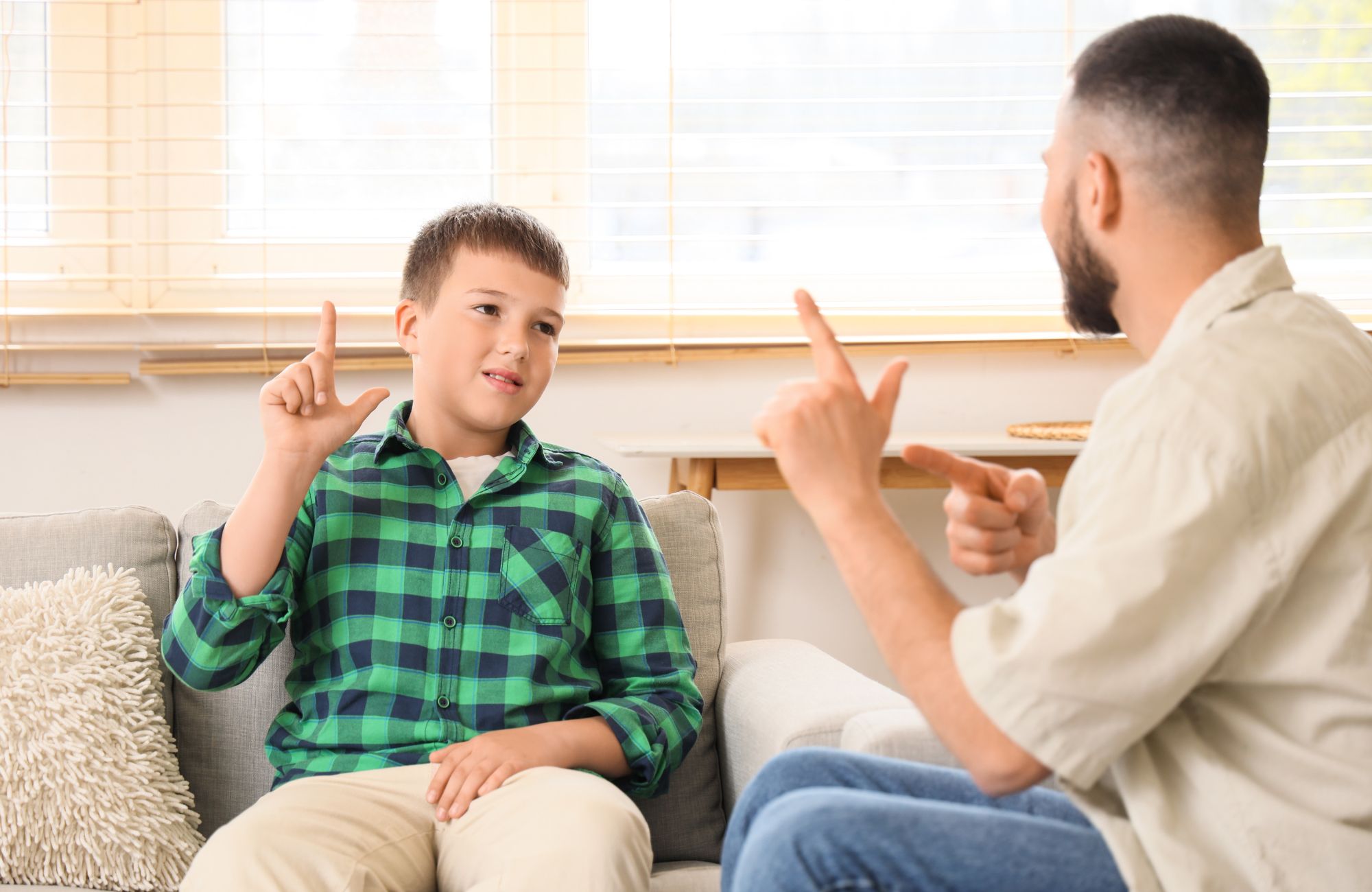
Nonverbal communication may include body language, gestures, facial expressions, sounds, and other movements. Some nonverbal or minimally verbal children with autism spectrum disorder may also use visual aids, sign language, AAC, or other assistive devices to communicate.
The word “nonverbal” is commonly used in searches and everyday conversation, although professionals and families may also use terms such as nonspeaking or minimally speaking. A lack of spoken language does not mean a child has nothing to communicate. The National Institute on Deafness and Other Communication Disorders notes that autistic children vary widely in their spoken and language skills, and some communicate through signs, pictures, or electronic systems instead of speech.
Communication may include:
- Pointing or reaching
- Facial expressions
- Hand or body gestures
- Sounds and vocalizations
- Signs
- Pictures and symbols
- Communication boards
- AAC apps
- Speech-generating devices
- Written or typed language
- Single words or short phrases
These methods can also work together. The American Speech-Language-Hearing Association, or ASHA, explains that a person may use multiple AAC and communication modes depending on the situation, communication partner, and purpose of the message.
Start by Recognizing How Your Child Already Communicates
Before introducing a new communication technique, notice how your child already expresses wants, refusals, interest, discomfort, or requests for help. Reaching toward an item, handing over an object, moving away, pointing, vocalizing, or selecting a symbol may already have a meaningful communication function in a familiar situation.
For example, imagine a child hands a parent a closed container of crackers. That action may mean “open this,” “help me,” or “I want crackers.” Instead of requiring a spoken word before responding, the parent can acknowledge the message and model an appropriate word, sign, picture, or AAC symbol based on the child’s established communication system.
A simple observation process can help parents respond more consistently:
- Observe what happened before the communication. What was the child doing or trying to access?
- Notice what the child did. Look at gestures, sounds, body movement, pictures, AAC, or spoken language.
- Consider the likely purpose. Was the child requesting, refusing, asking for help, commenting, or seeking attention?
- Respond and model. Acknowledge the message and model another communication option when appropriate.
Avoid assigning one fixed meaning to every sound or body movement. The same action can mean different things in different situations, which is why communication goals should reflect the individual child’s skills, needs, and patterns.
7 Communication Strategies for Nonverbal Autistic Children
Useful communication strategies make it easier for a child to send and receive meaningful messages throughout the day. Parents can respond to existing communication, use clear language, provide enough processing time, offer choices, model visual or AAC communication, and create natural opportunities to communicate during play, meals, dressing, and other routines.
Here are seven practical strategies parents and caregivers can consider.
1. Respond to Communication Attempts
When a child points, gestures, selects a symbol, uses an AAC device, vocalizes, or communicates in another established way, respond promptly when possible. Doing so shows that communication can influence what happens around them.
Suppose your child hands you a favorite toy that needs to be turned on. You might acknowledge the request, say “help,” and model “help” using the child’s communication board or AAC system. The goal is not to withhold help until the child copies you. Instead, you are giving language to a communication attempt that already has meaning.
2. Use Clear and Concise Language
Clear language can make spoken information easier to process. Instead of giving several directions at once, use wording that matches your child’s language skills and understanding.
For example, rather than saying, “Go upstairs, find your blue shoes, put them on, and then come downstairs because we’re leaving,” a parent might break the routine into smaller steps. Visual supports can also help when a child understands information more easily through pictures than spoken instructions alone.
Simple language should still remain respectful and age-appropriate. The goal is clarity, not talking down to the child.
3. Allow Enough Processing Time
After asking a question, giving a direction, or offering a choice, give your child time to respond. Some children need more time to process spoken language and organize their response, especially when they are using pictures, gestures, AAC, or another alternative communication method.
Parents may naturally repeat a question when they do not see an immediate response. However, asking it several times in quick succession can add more information to process. Pause, observe, and look for nonverbal cues before repeating or changing the prompt.
ASHA includes increased wait time among communication-partner strategies that can support people who use AAC.
4. Model Gestures and Visual Communication
Visual aids, gestures, and assistive technologies can make communication easier to understand and use. Some children may benefit from American Sign Language or simpler manual signs, while others may use pictures, AAC, or communication boards. The goal is to improve communication by matching supports to the child’s abilities rather than expecting every child to use the same method.
Visual supports can also make routines and transitions easier to understand. For example, a simple visual schedule might show “breakfast,” “get dressed,” “shoes,” and “school” in sequence.
Modeling is different from repeatedly testing a child. Parents can show how communication works without asking the child to copy every gesture, symbol, or word immediately.
5. Offer Meaningful Choices
Choices create a natural reason to communicate because the child’s response changes what happens next. Instead of asking an open-ended question that may be difficult to answer, a parent can begin with two realistic options.
For example:
“Apple or crackers?”
The child might point, reach, look toward an option if eye gaze is an established response for them, select a picture, use sign language, press an AAC symbol, or say a word. The important part is recognizing the child’s reliable communication method rather than requiring one specific form of verbal communication.
6. Use AAC When Appropriate
Augmentative and alternative communication (AAC) refers to communication methods that supplement or replace speech. AAC may be unaided, such as gestures and manual signs, or aided, such as picture boards, communication books, apps, and speech-generating devices. A child may use spoken words, gestures, signs, pictures, or an AAC device together, depending on the situation.
Families can also review common AAC options in this guide to communication devices for nonverbal children. The right system should reflect the child’s needs, abilities, daily environments, and communication partners.
7. Build Communication Into Everyday Activities
Communication practice does not need to happen only during structured therapy. Meals, play, getting dressed, bathing, household routines, and preparing for school all create real reasons to request, refuse, comment, ask for help, or make choices.
A child who wants a favorite toy opened has a natural reason to communicate “help.” A child choosing pajamas can practice making a choice. A child who needs a quieter environment may learn an appropriate way to communicate “break” or “too loud.”
For some families in Dumont and Bergen County, home-based support may help communication goals fit more naturally into daily routines. When appropriate, these services can address functional communication skills during familiar activities like meals, play, and transitions.
What Is Functional Communication?
Functional communication means using an effective method to convey messages that matter in everyday life. A child might communicate to request an item, refuse something, ask for help, express discomfort, make a choice, comment, or connect socially. Spoken language is only one possible method for accomplishing these communication goals.
It is easy to think of communication mainly as requesting things, such as saying or selecting “juice.” However, meaningful communication includes much more. ASHA describes AAC goals that include expressing wants and needs, exchanging information, building social closeness, and participating in social routines.
| Communication Purpose | Everyday Example |
| Request | “I want crackers.” |
| Refuse | “No more.” |
| Ask for help | “Help open it.” |
| Make a choice | “Blue shirt.” |
| Express discomfort | “Too loud.” |
| Comment | “Big dog.” |
| Get attention | “Mom.” |
| Social interaction | “Hi Grandma.” |
A communication system should therefore include useful vocabulary beyond favorite foods and toys. Words or symbols for “stop,” “help,” “hurt,” “break,” people, places, emotions, social messages, and the child’s interests may all matter depending on the individual.
AAC vs. PECS: What Is the Difference?
AAC is the broad category of methods used to support communication when speech alone does not meet a person’s needs. PECS, or the Picture Exchange Communication System, is one specific picture-based approach within the wider communication landscape. AAC can also include signs, boards, apps, and speech-generating technology.
The difference matters because parents may hear “AAC,” “PECS,” and “communication device” used as though they mean the same thing. They do not.
| Feature | AAC | PECS |
| What it is | Broad category of communication methods | A specific picture-exchange approach |
| Possible methods | Gestures, signs, boards, apps, devices | Exchanging pictures |
| Requires electronics | No | No |
| Can include speech-generating devices | Yes | No |
| Individualization | Many possible systems | Uses a defined picture-exchange procedure |
AAC can be low-tech or high-tech. A laminated communication board and a tablet-based speech-generating app are both forms of AAC.
Does AAC Prevent an Autistic Child From Learning to Speak?
No. Current evidence does not support the idea that using AAC prevents the development of spoken language. AAC gives a child another way to communicate, and it can be used alongside vocalizations or spoken words. Some children later use more speech, while others continue to rely primarily on AAC or several communication methods together.
This distinction matters because waiting for speech before introducing another reliable communication option can limit a child’s opportunities to express needs and ideas. NIDCD has specifically noted that research does not support the common concern that AAC hinders spoken language development.
At the same time, AAC should not be promoted as a guaranteed way to produce speech. The immediate goal is effective communication.
How Can Parents Be Better Communication Partners?
Parents can support communication by making it easier for their child to participate rather than placing all responsibility on the child. Helpful communication partners notice existing signals, provide enough response time, model useful language, keep AAC tools accessible, and respond to meaningful communication instead of requiring one specific form such as speech or eye contact.
ASHA considers family members and other communication partners an important part of AAC assessment and intervention. Communication partners can help identify useful vocabulary, daily needs, and situations in which the child needs reliable access to communication.
Parents can support this process by:
- Responding to meaningful communication attempts
- Giving the child time to answer
- Modeling words, symbols, gestures, or AAC
- Keeping communication tools available throughout the day
- Following the child’s interests during play
- Creating communication opportunities without constant testing
- Respecting an effective response even when it is not spoken
- Prioritizing shared engagement rather than forcing eye contact
Interactive play is especially useful because it gives communication a real purpose. If a child enjoys bubbles, rolling a ball, nursery rhymes, toy cars, or swinging, a parent can pause naturally to create opportunities for messages such as “more,” “go,” “stop,” “again,” or “my turn.”
Parents who want more guidance on using strategies consistently at home can also explore Apple ABA’s guide to parent training in ABA therapy.
What Communication Strategies Look Like at Home
Everyday routines provide useful communication opportunities because the child already has a reason to participate. Instead of creating a separate drill for every skill, parents can notice moments during meals, play, dressing, transitions, and breaks when a gesture, picture, AAC message, sign, sound, or spoken word can serve a meaningful purpose.
During Meals
Suppose a child wants cereal at breakfast. They might point toward the box, hand a parent a cereal picture, select “cereal” on an AAC device, make a familiar sound, sign the word, or say part of the word.
The parent can acknowledge the request and, where appropriate, model a slightly expanded version. If the child selects “cereal,” for example, the adult might model “want cereal” without making access to breakfast depend on copying the longer phrase.
During Play
Play creates opportunities for requesting, commenting, social interaction, and problem-solving. Imagine a toy car gets stuck inside a container.
The child may hand the container to a parent. The parent can interpret that established action as a possible request for assistance, say “help,” and model the child’s usual communication method for “help.” Once the container opens, play continues, giving the communication an immediate real-world purpose.
When a Child Needs a Break
Communication also helps children refuse, stop, or ask for space. Depending on the child’s system, useful messages could include:
- “Break”
- “All done”
- “Stop”
- “Quiet”
- “Too loud”
- “Help”
The exact response can vary. What matters is giving the child an effective way to communicate the need rather than assuming a specific sound, movement, or challenging behavior always means the same thing.
How Can ABA Support Functional Communication?
ABA can support functional communication by identifying why a communication skill matters, teaching an effective alternative response, and helping the child use that response across real situations. Goals might involve requesting help, making choices, asking for a break, gaining attention, or using an established communication system with greater independence.
One ABA approach is Functional Communication Training (FCT). FCT identifies the purpose a challenging behavior may serve and teaches a more effective communication response that can achieve the same outcome. For example, if a child regularly becomes distressed when they need a break, treatment may focus on teaching an accessible way to request that break.
A 2025 meta-analysis on functional analysis found strong effects of FCT for reducing challenging behavior and moderate-to-large effects for increasing replacement behaviors in young autistic children, while also noting that the research base still has methodological limitations.
Parents who want a more detailed explanation can read Apple ABA’s guide to functional communication training for autism.
ABA and speech-language services also have different areas of expertise. ASHA notes that speech-language pathologists play a central role in AAC assessment, while behavior specialists may help identify communicative intent and incorporate AAC into daily activities. Collaboration can help keep communication support consistent across settings.
When Should Parents Seek Professional Communication Support?
Parents should consider professional guidance when a child has difficulty communicating basic needs, is frequently misunderstood, lacks a reliable communication method across settings, or experiences a change or loss in previously used communication skills. Professional input can also be helpful when families are considering AAC or want to better understand a child’s speech and language development.
A speech-language pathologist can assess speech, language, and communication and may evaluate AAC needs when appropriate. NIDCD identifies speech-language pathologists as professionals trained to evaluate communication abilities and develop individualized treatment plans for autistic children with speech or language needs.
ABA professionals may address functional communication when those goals are part of the child’s individualized treatment plan. For some families, home-based support can make it easier to practice communication skills during familiar routines while coordinating with other professionals when needed.
Families in Dumont or elsewhere in Bergen County can explore professional support if communication challenges are affecting daily routines.
Communication Strategies to Avoid Using Too Rigidly
Communication strategies should support the child’s ability to express meaningful messages, not force one “correct” response.
Avoid turning communication practice into a set of rigid rules. In particular:
- Do not require eye contact before acknowledging a child’s communication.
- Do not insist on speech when the child has another effective communication method available.
- Do not repeatedly ask the same question without allowing processing time.
- Do not remove an AAC device simply because a child has started producing words.
- Do not assume a lack of spoken language means a lack of understanding.
- Do not select an AAC system solely because it worked for another child.
Conclusion
Communication can take many forms, including gestures, pictures, AAC, signs, body movements, vocalizations, and spoken language. The most effective approach is one that helps the child communicate meaningful needs, choices, feelings, and ideas in a way that fits their abilities and daily routines. Parents can support this by noticing existing communication, allowing processing time, modeling useful language, and practicing skills during everyday activities.
Apple ABA helps families in Dumont and across Bergen County build individualized ABA strategies for daily routines. Through assessment, home-based sessions, progress monitoring, and caregiver collaboration, BCBAs can support meaningful communication, social, behavioral, and daily living skills at home. The team can help determine which supports fit your child’s communication, comfort, safety, and learning needs. Contact us to learn how personalized in-home ABA therapy may support your child’s growth and independence.
FAQs
How to communicate with a non-verbal 3 year old?
Start with the child’s current communication skills and interests. Use simple language, gestures, pictures or other visual supports, offer meaningful choices, pause for a response, and acknowledge communication attempts even when they are not spoken. A speech-language pathologist can evaluate speech and language development, while other professionals may support functional communication goals as appropriate.
How do nonverbal autistic people communicate?
Nonspeaking and minimally speaking autistic people can communicate through gestures, signs, facial expressions, body movement, pictures, writing, communication boards, AAC apps, speech-generating devices, vocalizations, or combinations of these methods. Some also use spoken words in certain situations. The best method depends on the person’s individual communication needs and abilities.
Does AAC stop an autistic child from learning to talk?
No. Available research does not support the concern that AAC prevents spoken language development. AAC can be used alongside vocalizations and speech, providing another communication option while language continues to develop. It should not be presented as a guarantee that a child will eventually use spoken language.
What is the difference between AAC and PECS?
AAC is the broader category of methods used to supplement or replace speech, while PECS is a specific picture-exchange approach. AAC can include gestures, manual signs, communication boards, apps, and speech-generating devices. The most appropriate communication system depends on the person’s abilities, needs, environments, and communication partners.