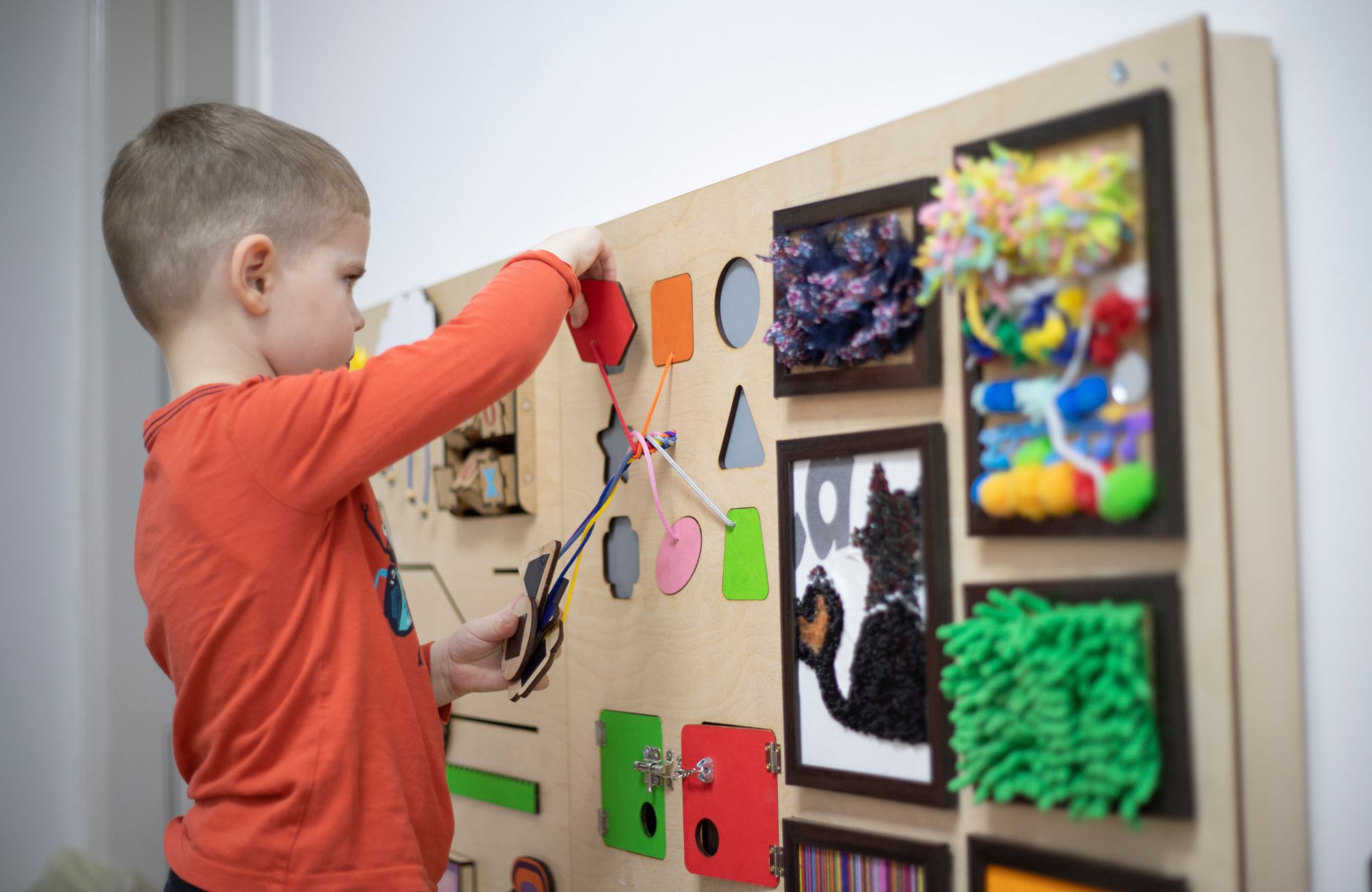
Teaching listening skills to an autistic child works best when listening is treated as a communication skill, not simply as following orders. A child may need extra time to understand words, filter background noise, shift attention, or figure out what a conversation partner means. Parents can make listening easier by using short directions, reducing distractions, allowing processing time, pairing spoken words with visual supports, reinforcing useful communication, and accepting responses through speech, gestures, AAC, pointing, typing, signing, or action.
For families in Wood-Ridge and Bergen County, these skills can be practiced naturally during meals, play, getting ready for school, and other familiar activities. Families who want additional support can learn more about home-based ABA therapy in Wood-Ridge and how communication goals may be addressed within everyday routines.
What Does Listening Mean for an Autistic Child?
Listening means more than hearing words or looking at the person who is talking. It can involve noticing important information, understanding language, managing competing sounds, allowing enough processing time, and responding in a way that makes sense for the child. Good listening also does not require constant eye contact.
Autistic children have different communication strengths and needs. Some children understand spoken language easily but need more time to respond. Others may find long verbal instructions difficult or use gestures, pictures, written words, signs, or augmentative and alternative communication alongside speech.
NIDCD notes that autistic children can have difficulty understanding what other people say as well as using spoken and nonverbal communication. This is why parents should avoid assuming that a child who does not respond right away is ignoring them on purpose.
Hearing, Listening, and Understanding Are Different
Parents may use “listening” to describe several different skills. Knowing the difference can make it easier to choose the right support.
| Skill | What It Means | Example |
| Hearing | Detecting sounds | Hearing the doorbell |
| Listening | Paying attention to relevant sound or speech | Attending when a parent gives an instruction |
| Receptive language | Understanding language | Understanding “Put your cup on the table” |
| Following directions | Understanding and completing an instruction | Putting the cup on the table after being asked |
| Auditory processing | Making sense of auditory information | Understanding speech when other sounds are present |
A child can hear a parent clearly and still have difficulty understanding a long instruction. Likewise, a child may understand the words but need more time to shift attention from another task before responding.
Why Can Listening Be Difficult for Children With Autism?
Listening can become difficult when a child has to manage language, attention, sensory input, and a task at the same time. Background noise, long instructions, unfamiliar words, emotional stress, or rapid conversation can add to the demand. The exact reason varies, so parents should focus on what helps the individual child understand and communicate.
Several factors may affect listening during different situations:
| What You Notice | What May Be Making the Task Harder | Helpful Support |
| Child completes only part of a direction | Too many steps at once | Start with a shorter direction |
| Responses are slower than expected | More processing time may be needed | Pause before repeating |
| Listening is harder in busy rooms | Competing background noise | Reduce unnecessary noise |
| Child seems confused by instructions | Language may be too complex | Use clear, concrete words |
| Certain sounds cause distress | Sensory demands may interfere with attention | Adjust the environment when possible |
| Child regularly misses speech or sounds | A hearing concern may need consideration | Discuss it with an appropriate professional |
Receptive language refers to the ability to understand what others communicate. NIDCD explains that children who have trouble understanding what others say may have receptive-language difficulties, while hearing concerns are a separate issue that may also require evaluation.
Background Noise and Sensory Processing
A simple instruction can become much harder when a television is playing, family members are talking, and appliances are running nearby. Autistic children can also experience differences in their responses to sensory input, although the specific sounds and situations that affect them vary widely.
For example, telling a child, “Get your shoes, put your lunch in your bag, and wait by the door,” may be difficult while several other things are happening. Turning down competing noise and starting with one clear step can reduce the amount of information the child needs to sort through at once.
A Simple Way to Check What Support May Help
When listening is difficult, it can help to look at the situation before assuming the child is ignoring the instruction. Parents can consider whether the message was clear, whether the environment made listening harder, and whether the child had an accessible way to respond.
- Access: Can the child hear, notice, or attend to the message in the current environment?
- Language: Is the direction short, concrete, and matched to the child’s understanding?
- Environment: Are background noise, sensory discomfort, stress, or transitions making listening harder?
- Response options: Can the child respond through speech, gesture, AAC, pointing, signing, typing, or completing the action?
- Reinforcement: Is successful listening or communication acknowledged in a way that is meaningful to the child?
For example, if a child does not respond to “Get ready to leave,” the next step may be to reduce background noise, use a visual cue, or give one clear direction such as “Shoes on,” rather than repeating the same instruction louder.
8 Practical Strategies for Teaching Listening Skills to an Autistic Child
Effective listening practice should match the child’s communication abilities, interests, sensory needs, and current skills. Parents do not need to rely only on spoken instructions. Visual supports, gestures, demonstrations, AAC, and other communication methods can work alongside speech to make meaning clearer.
1. Start With Short, Clear Instructions
Clear instructions make it easier for a child to understand what action comes next. Use specific words and remove extra language that does not help with the task.
Instead of saying, “Could you please finish what you’re doing, go upstairs, brush your teeth, put on your pajamas, and then come back down?” start with a manageable direction such as:
“Go brush your teeth.”
Once one-step directions become easier, more steps can be introduced gradually when appropriate. For related examples, see this guide to teaching following directions in autism
2. Allow Time to Process the Direction
After giving an instruction, pause before saying it again. Some children need extra time to understand the language, shift their focus, decide what to do, and begin the task.
Repeating the same instruction rapidly can sometimes create even more auditory information to process. Instead, stay calm, give the child a reasonable chance to respond, and add another type of support if the message still seems unclear.
3. Reduce Unnecessary Background Noise
A quieter environment can make spoken information easier to notice when competing sounds are distracting or overwhelming. Parents might lower the television, pause music, or move closer before giving an important direction.
The goal is not to make every environment silent. Children eventually use communication skills in many settings, so practice can gradually include different environments while still respecting sensory comfort and individual needs.
4. Pair Spoken Words With Visual Supports
Visual supports can give a child another way to understand what is being communicated. They may include pictures, written words, schedules, objects, demonstrations, or gestures.
For example, when saying “Shoes on,” a parent might point to the shoes. A morning routine could pair short verbal directions with a picture schedule showing getting dressed, eating breakfast, brushing teeth, and packing a school bag.
Visual support does not mean a child is failing to listen. It simply gives them more than one way to access the information.
5. Practice During Activities the Child Enjoys
Motivating activities can create natural opportunities to practice listening without turning every interaction into a lesson. A child who enjoys building blocks, music, cooking, animals, or movement games may be more willing to engage when practice happens within those interests.
During a building activity, for example, a parent might say, “Give me the blue block” or “Put the car on top.” Keep the activity enjoyable and adjust the difficulty if the child starts to struggle.
6. Use Songs, Rhythm, and Sound When Helpful
Some children enjoy learning through songs, rhythm, rhyme, or repeated sound patterns. Music can be a useful tool for routines such as cleaning up, washing hands, or transitioning between familiar activities.
However, autistic children do not all have the same auditory preferences. If music or repeated sounds cause discomfort, another approach may work better. Tailored strategies matter more than labeling a child as an “auditory learner.”
7. Reinforce Useful Listening and Communication
Positive reinforcement means providing a meaningful consequence after a behavior so that the behavior becomes more likely in similar situations. Reinforcement may include specific verbal praise, access to a preferred activity, a high-five if the child enjoys it, or another individualized outcome.
For example, a parent might say, “You put your cup on the table when I asked. Nice listening,” and then continue with an activity the child enjoys. Reinforcement should match the child’s preferences rather than relying on the same reward for every child.
Caregivers may also benefit from learning how parent training in ABA therapy can support communication, daily routines, and skill-building at home.
8. Accept Different Ways of Responding
Listening does not always result in a spoken answer. A child may respond by pointing, moving toward an item, selecting a picture, signing, typing, using an AAC device, or completing the requested action.
The American Speech-Language-Hearing Association describes AAC as a broad range of communication approaches that can supplement or replace speech when needed. Supporting these communication methods gives children additional ways to express wants, refusals, questions, and other messages.
How Can Parents Practice Listening Skills During Daily Routines?
Daily routines give children repeated chances to practice listening in situations that already have a purpose. Parents can use short instructions, consistent wording, visual cues, and natural reinforcement during mornings, meals, play, cleanup, and bedtime. Familiar routines also make it easier to adjust the level of support as new skills develop.
Morning Routine
Morning routines often involve several tasks, so avoid giving every instruction at once. Try one clear direction, allow time for the child to respond, and use a visual schedule when helpful.
For example:
“Put on your shirt.”
After that step is complete:
“Now get your socks.”
Over time, a child who understands each step may become ready for a longer sequence.
Mealtime
Mealtimes provide opportunities to practice choices, requesting, following simple instructions, and conversation skills. Parents can ask clear questions such as, “Do you want water or milk?” while showing the choices if visual support helps.
The goal should be functional communication rather than testing whether the child knows the “correct” answer.
Play and Cleanup
Play creates natural opportunities for following directions and social interaction. Parents might practice “Roll the ball,” “Put the bear in the car,” or “Your turn” while following the child’s interests.
Cleanup can also include consistent cues such as “Blocks in the box.” A song or visual cue may help if the child enjoys those supports.
Bedtime
Predictable bedtime routines reduce the amount of new information a child has to process. Use consistent language for recurring steps such as changing clothes, brushing teeth, choosing a book, and getting into bed.
Families can also use response priming for autism before less familiar routines or changes. Priming can use simple explanations, visual supports, role-play, or practice to help a child know what to expect.
How Do Visual Supports and AAC Help With Listening?
Visual supports and AAC can make spoken information easier to understand while giving children additional ways to respond. They are not opposites of listening. A child may hear a verbal direction, look at a picture schedule, and answer through speech, gesture, typing, signs, or an AAC device during the same interaction.
A multisensory or multimodal approach may be especially useful when words alone do not provide enough information. Parents can combine communication methods based on the situation rather than requiring every interaction to happen through speech.
| Situation | Spoken Support | Additional Support |
| Starting a routine | “Time to brush teeth” | Picture schedule |
| Making a choice | “Apple or banana?” | Show both choices |
| Completing a task | “Put it here” | Point to the location |
| Preparing for a change | Explain what happens next | Visual sequence |
| Requesting help | Model useful words | Keep AAC or other communication available |
Varied communication methods also respect the fact that communication abilities can differ widely among autistic children. NIDCD recognizes both spoken-language interventions and alternative or augmentative communication approaches for autistic children with limited speech.
How Can ABA Support Listening and Following Directions?
ABA may help teach functional listening-related skills when they are meaningful to the child and family. A treatment goal might involve understanding a safety instruction, completing a daily routine, responding to relevant cues, requesting help, asking for clarification, or communicating the need for a break rather than simply teaching obedience.
A BCBA may look at the child’s current skills, the environment, what happens before and after the behavior, and the purpose of the skill. Teaching can then begin at an appropriate level and become more complex as the child develops greater independence.
A practical process may include:
- Define the specific skill the child needs.
- Check whether the child understands the language involved.
- Start with an achievable level of difficulty.
- Use prompts or visual supports when needed.
- Reinforce successful communication and participation.
- Practice during meaningful routines.
- Gradually use the skill with different people or settings.
For example, a child who does not respond when a parent says, “Clean the whole room before dinner,” may first practice a clear direction such as, “Put the cars in the box.” As the skill becomes easier, the task can gradually include additional steps.
For families in Wood-Ridge and Bergen County, home-based ABA therapy can support communication and daily living skills within familiar routines. This may include family collaboration and individualized goals based on the child’s needs.
What Should Parents Avoid When Teaching Listening Skills?
Teaching listening should support understanding, communication, and independence rather than forcing a child to appear attentive. Requiring eye contact, repeatedly increasing the volume of instructions, or treating every delayed response as a behavior problem may overlook language, sensory, hearing, or processing factors that affect the interaction.
Parents can make practice more supportive by avoiding a few common mistakes:
- Do not require eye contact as proof that the child is listening.
- Avoid giving several instructions at the same time before the child can handle them.
- Do not repeat directions rapidly without allowing processing time.
- Avoid adding louder speech when sound is already overwhelming.
- Do not remove visual supports simply because spoken language is present.
- Avoid assuming that refusal, distress, or delayed responses always mean deliberate noncompliance.
- Do not compare the child’s listening behavior with siblings or classmates.
Listening also involves two people. A supportive conversation partner pays attention to whether the message was clear, whether the environment made communication harder, and whether the child has an accessible way to respond.
When Should Families Seek Additional Evaluation?
Parents should consider professional guidance when listening concerns may involve more than learning or behavior. Persistent difficulty hearing speech, understanding language, tolerating sounds, communicating needs, or responding across settings may warrant discussion with the child’s pediatrician or another qualified professional who can help determine what type of evaluation is appropriate.
An audiologist can assess hearing concerns, while a speech-language pathologist can evaluate speech and language skills. Occupational therapists may also address functional needs related to sensory processing when appropriate. ABA professionals can collaborate with these providers when listening-related goals overlap with behavior, communication, routines, or participation.
Hearing deserves particular attention when there are concerns about speech or language because hearing differences can affect access to spoken information. The American Academy of Pediatrics identifies hearing loss as an important consideration in children with delayed or disordered speech and language, so families should raise persistent listening, hearing, or language concerns with the child’s pediatrician or another qualified professional.
Conclusion
Teaching listening skills to an autistic child works best when parents focus on understanding, communication, and meaningful participation rather than compliance alone. Clear instructions, visual supports, processing time, positive reinforcement, and daily practice can make communication easier, while other professionals may help when hearing, speech-language, or sensory concerns need further evaluation.
Apple ABA helps families in Wood-Ridge and across Bergen County build individualized ABA strategies for daily routines. Through assessment, home-based sessions, progress monitoring, and caregiver collaboration, BCBAs help children practice meaningful communication, social, behavioral, and daily living skills at home. The team can determine which supports fit your child’s communication, comfort, safety, and learning needs. Contact us to learn how personalized in-home ABA therapy can support your child’s growth and independence.
FAQs
How do you teach an autistic child to listen?
Start with short, clear instructions and give the child time to process what was said. Reduce background noise, use visual supports when helpful, and practice during familiar routines or activities the child enjoys.
What are effective listening strategies for autistic children?
Helpful strategies include one-step directions, visual cues, predictable routines, modeling, positive reinforcement, processing time, and manageable tasks. The best approach depends on the child’s communication abilities, sensory needs, and interests.
Does an autistic child need eye contact to show they are listening?
No. Eye contact is not required for listening, and it may be uncomfortable or distracting for some autistic children. Focus on whether the child understands, responds, or completes the relevant action.
Can visual supports improve listening skills?
Yes. Pictures, written directions, visual schedules, gestures, objects, and demonstrations can make spoken information easier to understand and give the child another way to follow along.